

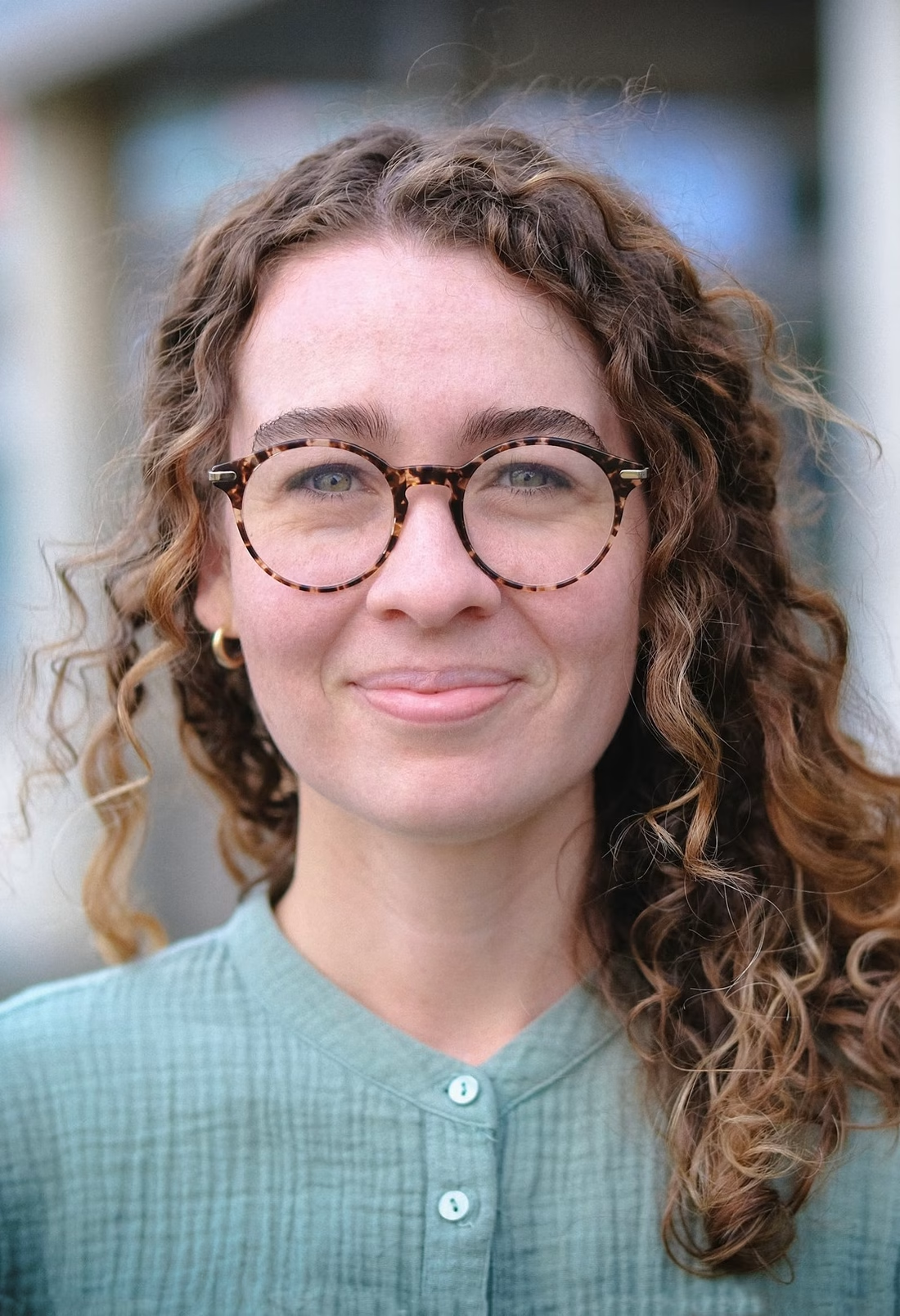
What changes in your brain when you use cannabis or psychedelics? And how can you use this to treat (mental) disorders? Natasha Mason, assistant professor at the Faculty of Psychology and Neuroscience (FPN), received the €15,000 Hustinx Science Award for her research on this topic during the opening of the 2023 academic year.
(Photo: Joey Roberts)
That was the advice an American professor gave Natasha Mason, then a psychology student at the University of Wisconsin in Madison, about ten years ago. Her question to the professor? How could she best conduct scientific research on psychedelic drugs?
Her interest in this arose when she stumbled upon a study in the literature in which depression and anxiety disorders were treated with psychedelics. "I was fascinated by the question of how medications make people feel better. But in practice—I worked in a pharmacy alongside my studies—I also saw the downsides of certain medications, especially antidepressants and opiates. Many people complained that they didn't work, but at the same time, they couldn't live without them. How different was the picture in that study with psychedelics: many participants felt better after a single treatment, and that effect lasted for months."
But further research? That had been out of the question in the United States since psychedelic drugs were banned in the late 1960s—a period when LSD, in particular, was soaring in popularity. What remained was a huge stigma. So, she'd better keep her interest to herself, the professor explained. "He was afraid people would dismiss me as a hippie or a drug addict. 'Just wait another twenty years, maybe the time will be right,' he told me."
Mason ignored that advice. Fortunately, because those twenty years were a major error of judgment, the American now concludes, sitting in the cafeteria at Universiteitssingel 40 in Randwyck. For nine years, she has been researching psychedelics and cannabis in this building. First as a PhD candidate, now she is a university lecturer. In the meantime, a true "psychedelic renaissance" has taken place, she says.
“More and more studies with promising results appeared worldwide, which also increased attention and resources.”
Even in her home country, the mood has completely shifted, Mason notes. "Ten years ago, Maastricht was one of the few places in the world where clinical trials with psychedelics were taking place in humans. That's why I came here. Now there are dozens of research groups, many of them in the United States, even at prestigious institutions."
In Maastricht, Mason focuses on how drugs influence brain function—and thus human behavior. "For example, by examining the brains of people under the influence in an MRI scanner, or by having them complete questionnaires." She examines both immediate and long-term effects. "Consider, for example, an increase in creativity, which is often associated with psychedelics. We discovered that after taking psilocybin, the active ingredient in magic mushrooms, subjects were actually less creative when performing tasks. But a week later, they did appear to have many more new ideas than people in the placebo group."
These are properties like these that are useful in treating mental health issues, Mason explains. "Psychedelics increase the brain's plasticity, creating new connections between brain cells. This process can enable us to think about things differently. Very useful for people with depression, for example, who are often stuck in certain ideas." By better understanding what happens in the brain, she hopes to improve therapies. "That means optimizing positive effects, but also minimizing negative ones."
There's still much to be gained in that last area, says Mason. "Take cannabis, which we're also researching here—in addition to psychedelics. More and more people are using it medicinally, for example, for pain management, but there are also risks involved. Especially for women. It's known that they often react worse to cannabis use. For example, it triggers anxiety more often in them, and they generally become addicted more quickly. But why? Little is known about that. In the past, research was often conducted exclusively with men."
Mason wants to use the €15,000 Hustinx Prize to investigate this. "Sex hormones may play a role. During certain parts of the menstrual cycle, when hormone concentrations peak, nerve cells may be more sensitive to cannabis. This could mean that women should use more or less cannabis at certain times during their cycle. We want to test this hypothesis with human subjects."
And so Mason is working on many more projects. And that's necessary, because the demand for knowledge is high, she says. "In the case of cannabis, we're actually already lagging behind. An estimated 4 percent of the world's population uses cannabis, and that number will only increase as it becomes legal in more and more places. At the same time, much remains unclear. Take, for example, the legal limit for alcohol consumption. That limit is clearly defined for alcohol, but hardly so for cannabis."
Science will also have to catch up on psychedelics. “I expect that psychedelic medicines will be available to the general public within five to ten years. You see more and more companies sensing a profit and wanting to market them as a ‘ready-made’ miracle cure. With the message: ‘Take this drug and your symptoms will be gone.’ But that’s not necessarily how it works. So far, most of the research has focused on therapy, where someone takes it under supervision. Little is known about the effects when people start using it on their own.”
“Let’s try to avoid a repeat of the 1960s for psychedelics.”
She therefore has mixed feelings about the current hype surrounding psychedelics, including on online forums like Reddit and in popular documentaries on Netflix. "You can see there's a lot of interest. When we put out a call for test subjects, we sometimes receive hundreds of emails within a single day, from people all over the world. On the one hand, that's great, but sometimes I'm also afraid it's happening too fast. You see drug laws being amended in more and more countries under public pressure. Let's try to prevent a repeat of the 1960s—when psychedelics 'escaped' from the lab too quickly, leading to prohibition and stigma. It's better to understand them properly first."
Source: Observant Online