

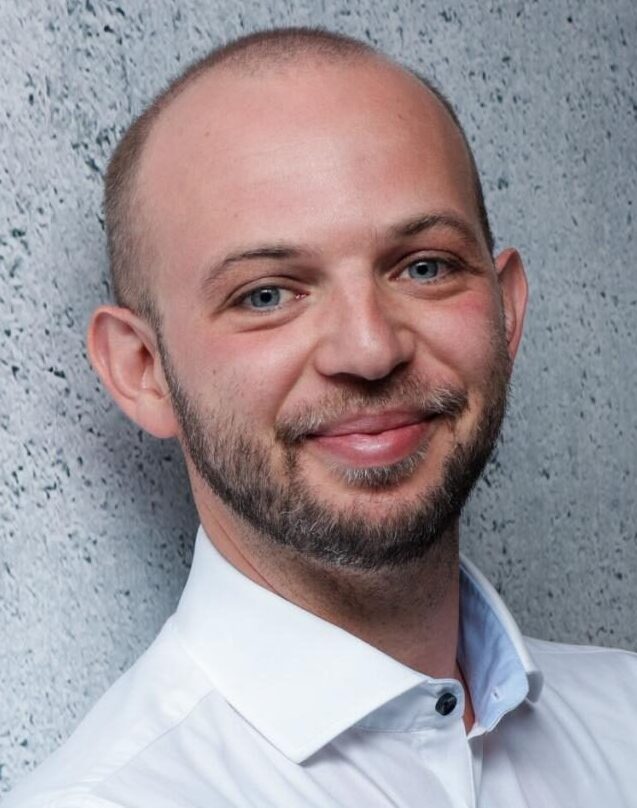
What influence does AI have on workplace relationships? During the opening of the academic year, scientist Roman Briker received the Hustinx Science Award for his research on this topic.
From helping with writing—or grading—essays, to sifting through stacks of papers or application letters, to relationship advice: AI is ubiquitous these days, at work, in school, and at home. How is it changing our behavior? "The field is currently exploding," says Moldovan-German Roman Briker, a university lecturer at the School of Business and Economics (SBE) with a background in psychology.
Many researchers focus primarily on how people use AI in their own work or lives. I'm actually interested in what it does to a group, how it changes social interactions. Little is known about that.
Something that's often overlooked, says Briker, is the influence of colleagues on someone's attitude toward AI, for example, when it comes to using ChatGPT or other AI applications at work. "If you notice that a colleague has confidence in you, you're more likely to have it yourself. Especially if that colleague is someone you find nice, smart, or helpful. The effect is actually less or even disappears if you don't like them. In other words: our attitude depends not only on how well the AI itself functions, but also on the social context."
Another question Briker is working on: how do workplace hierarchies and dynamics change when an AI system is your boss? "So, a computer that gives instructions, that assesses performance, and from whom you can ask for feedback. Or, going a step further, that determines who gets hired or fired, or how much someone earns." That might sound futuristic or even dystopian to many people, Briker agrees. "But you should already be researching such applications now. You have to try to predict where things will go. Otherwise, you'll be left behind. That's something you already do in academia—there are often years between the start of a study and publication—and you certainly notice that in this field, where developments are moving at breakneck speed."
For example, AI now possesses "properties" that researchers thought impossible ten years ago, says Briker. "Creativity, for example. AI models can now write beautiful poems and interesting stories, which people find more original than 'real' pieces in blind tests." AI as a "therapist" is also rapidly emerging: apps or robots that keep users company by chatting, or provide support and advice, for example, on relationship problems. "That's actually the most widely used application of AI right now. What helps is that developers are increasingly giving such systems more human traits: robots that move like real people, or a computer voice that takes short pauses, laughs, and interrupts."
People are increasingly seeing AI systems less as machines and more as colleagues, friends, coaches, or leaders, Briker observes. "And we're accepting that new role. More and more people are truly collaborating with them, developing relationships with them. That's a big difference from older technology. You didn't develop that kind of bond with your Firefox browser."
This means that even that AI boss is no longer just a pipe dream. "There are already companies that publicly claim to be run by AI, but those are still exceptions." What's much more common is what Briker calls "shadow AI": companies that already use it in certain ways, for example, for HR tasks like reviewing application letters, but don't advertise it publicly. "For fear of negative reactions."
“Because although we often think of ourselves as using AI correctly, we often think of others who do so as being lazy or overlooking AI errors.”
The same thing happens in the workplace. "At least half of the people keep quiet about the use of AI in their work or lie about it to their colleagues. Perhaps they fear for their jobs, because what if their boss thinks a computer can do their job too?"
While that fear isn't necessarily justified, Briker believes. "Ultimately, I see AI as a powerful tool you use in your work, not something that replaces you. One that can give you new ideas, act as a sparring partner, and help you with the tedious tasks. Research regularly shows that people who use AI in this way are much more productive."
Briker believes companies should therefore develop better AI guidelines for their employees. "So they know: what's okay with my boss? And what's legally permissible? People often have doubts about that. I advocate for more openness: let employees experiment. The genie's already out of the bottle, otherwise they'll just do it secretly."
Moreover, people also learn how not to use it. "AI isn't always 100 percent accurate and can also be biased, leading to discriminatory algorithms when hiring, for example. But if you use it wisely and carefully, AI can actually be much more objective than a biased, racist, or sexist boss."
Source: Observant Online
View the PDF“Roman's research, in which he collaborates with various sustainable disciplines, provides valuable insights that enable the embedding of AI.”
– Report of the jury of the Hustinx Science Award 2025